On this page
Start with a concrete applicationFour useful starting pointsA worked evaluationReusable decision recordPrimary references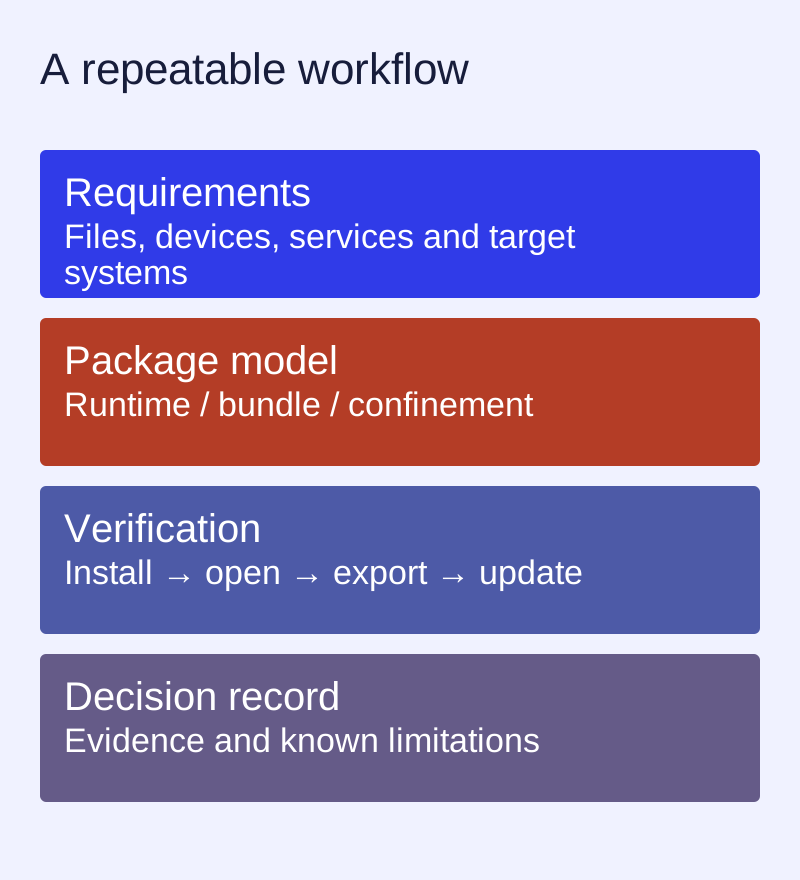
Start with a concrete application
Write down its dependencies, supported distributions, graphics stack, required devices, update channel and expected filesystem access. “Portable” does not mean independent of every kernel, driver or architecture. Test the target environments you actually support.
Four useful starting points
| Format | Read first | Question to resolve |
|---|---|---|
| Linyaps | Base, runtime, manifest and repository workflow | Which base/runtime and permissions does this app require? |
| Flatpak | Runtime and sandbox permissions | Can the workflow use portals rather than broad filesystem access? |
| Snap | Confinement and interfaces | Is the package strict, classic or devmode, and what interfaces connect? |
| AppImage | Application bundle and execution model | Which host requirements and update mechanism remain your responsibility? |
This table compares decisions to investigate. It is not a benchmark or a blanket security ranking.
A worked evaluation
Suppose a desktop editor needs to open a user-selected document, save an export and display through the desktop graphics stack. List those three actions separately. For each candidate package, record whether the file chooser uses a portal or direct access, where the exported file lands, and whether the target GPU/desktop combination works. Do not award a pass merely because the application opens.
- Install on a disposable test environment matching a supported distribution.
- Open a test document, save an export, close and relaunch.
- Inspect the granted access and repository trust policy.
- Test an update and confirm the user's document is still available.
- Record a failure and its exact environment rather than averaging it away.
Reusable decision record
Application / version:
Target distribution / architecture:
Required files, devices and services:
Package format and distribution channel:
Runtime/base requirements:
Permission and trust review:
Install / launch / export / update checks:
Known limitations:
Reason for the choice:
For Linyaps, continue with the runtime and manifest references. For the other formats, use their own current documentation; the same term can describe a different boundary.