Linyaps is an independent package management tool set for Linux across distributions. It has always been with the core goal of simplifying Linux application distribution and improving cross-platform compatibility, and building an efficient application ecological bridge for developers and users. With the in-depth participation of the Linyaps community and developers, we are continuing to polish and optimize, continue to improve the stability of containerization technology, optimize developers' workflow experience, and expand ecological coverage capabilities.
With the official release of deepin 25, Linyaps v1.9. 5 version also already Officially launched, the following is the key description and detailed update log of this version.
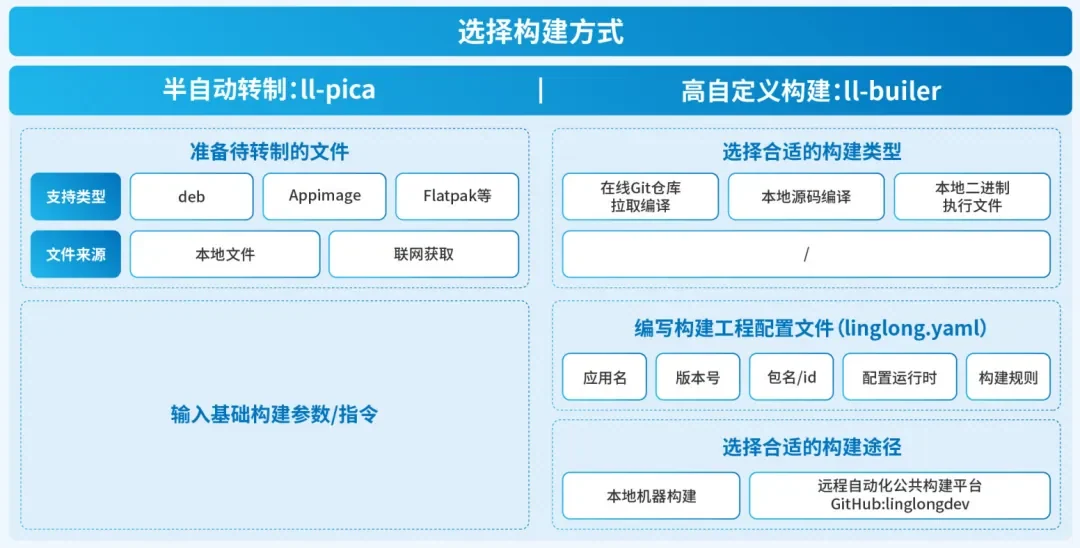
1. Linyaps UAB format: making Linux application distribution more flexible
In v1.9. 5 version, we Linyaps of Offline package Format UAB (Universal Application Bundle) format conduct Got it brand new of polish upgrade , At this stage UAB already Can comprehensive substitute original of layer format.
UAB of It is essentially an "archive compressed package" of the Linyaps application, more like a "transfer archive" than a traditional installation package, which contains the complete files required to run the application.
v1.9.5 version, we target land did some Performance Improvement and Efficiency Optimization , as : Supports compression algorithms such as lz4 and zstd to make the file size smaller (can be lighter than AppImage); integrates the dependent tool chain into ll-builder-utils to solve the compatibility issues of different Linux distributions and greatly improve the transmission and storage efficiency.
As an upgraded distribution format, UAB is a statically linked executable file, which comes with all the dependencies required for application operation and does not rely on additional environments of the user system - whether the user is using deepin, Ubuntu or other Linux distributions, it can be smoothly compatible, eliminating the trouble of repeated adaptation.
2. New ecological breakthrough: officially supports Linyaps-based operation of Wine applications
In a Linux environment, users cannot avoid You need to use some applications that are only available in Windows. At this time, the technical integration of Wine and Linyaps can bring a more flexible cross-platform experience to the Linux ecosystem - by encapsulating Windows applications into Linyaps packages, compatible operation of Windows applications is achieved, and the sandbox feature of Linyaps can be used to solve the problem of traditional dependency conflicts and make cross-platform applications run more stably.
Currently, the deepin wine team has released an independent Linyaps Wine operating environment:
-
runtime: deepin-wine8-stable integrated and deepin-wine-helper , follow-up Can Support deepin-wine10-stable version and continue to expand compatibility;
-
base: Contains all other basic dependencies, laying the foundation for the operating environment.
So far, 11 x86 applications and 3 ARM wine applications have been launched through Linyaps adaptation, such as enterprise WeChat, Format Factory, NetEase Mailbox Master and other common tools. Interested developers can directly convert the packaged deepin-wine8-stable deb application to Linyaps format through the Linyaps build tool (ll-builder) or using the Linyaps automated build platform (GitHub: linglongdev).
3. New milestone: Linyaps is integrated into the Arch Linux official repository
As an important step in the cross-distribution application ecosystem, Linyaps has been officially integrated into the Arch Linux official repository, further expanding the coverage of the Linux ecosystem.
Currently, Linyaps has supported 10+ mainstream Linux distributions, covering Debian, Fedora, Ubuntu, Arch and other systems.
Installation environment instructions
-
deepin 23 and deepin 25 are pre-installed with Linyaps environment and can directly run Linyaps applications;
-
Other distributions need to pre-install the Linyaps environment to experience the cross-platform application ecosystem.
Version acquisition channels
-
Linyaps community official version:
-
SIG compiled stable version (compiled and debugged by Linyaps Generic-Linux SIG):
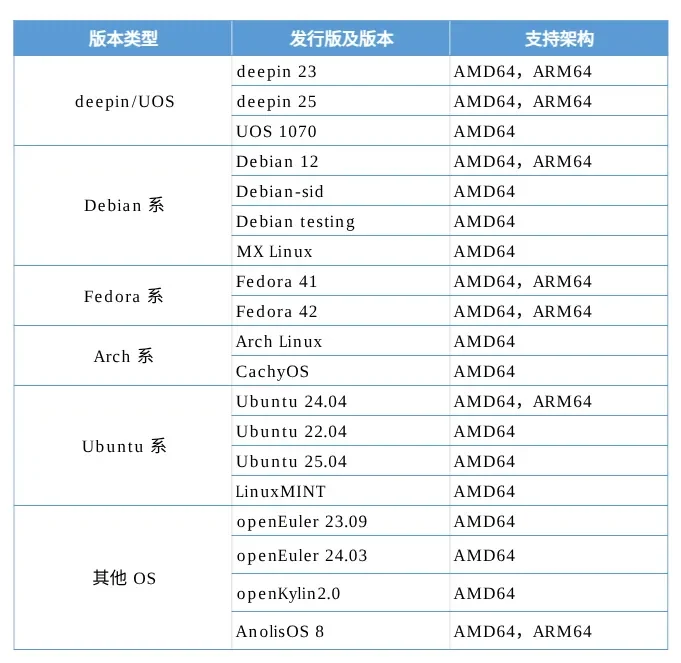
* Currently Loong64, MIPS64, and SW64 do not yet provide environment installation packages, and they need to be compiled by yourself before use.
4. Linyaps web application store upgrade: 5000+ applications have been launched
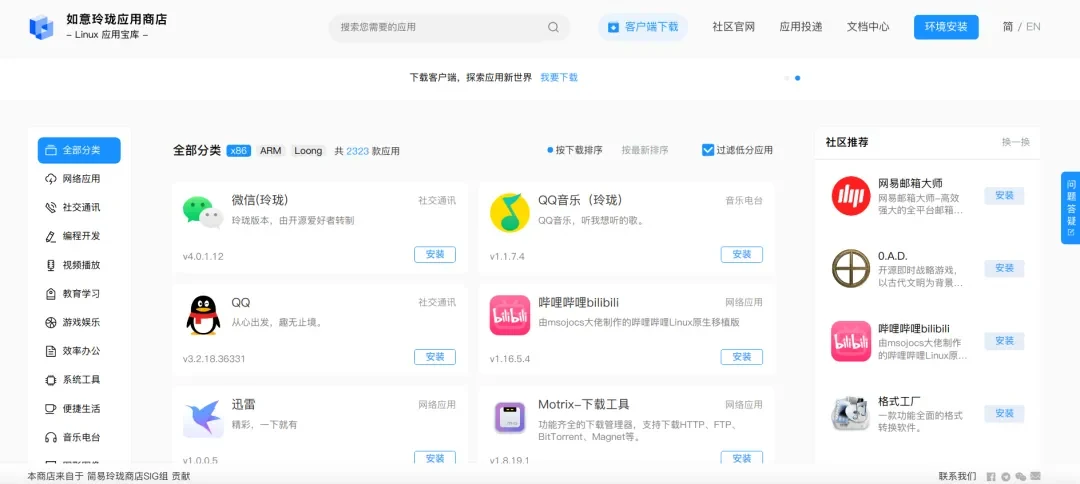
As the ecosystem continues to expand, the number of Linyaps applications has exceeded 5,000+, covering diverse scenarios such as office, tools, and entertainment. The web application store developed and maintained by Linyaps Simple Store SIG has also completed a new round of version updates and gone online, bringing a more considerate user experience.
-
Linyaps web store:https://store.linyaps.org.cn/
New feature highlights
-
Supports Chinese/English bilingual mode to adapt to the needs of international users;
-
can identify and filter CPU architecture to accurately match the applications required by the device;
-
Added new application filtering function to support filtering low-scoring applications and focus on high-quality experience;
-
Added a "Community Recommendation" module to discover more practical tools with high reputation.
5. Linyaps v1.9.5 complete update log
Container and build process optimization
- Introduce dumb-init as the container init process, which is used to forward signals and clean up zombie processes, and optimize process management within the container;
- Added support for Loongson and other architectures, and solved the GOT overflow problem of MIPS architecture by globally applying the -mxgot compilation flag;
- Support loading architecture-specific configuration files (such as linglong.arm64.yaml) through ll-builder to automatically adapt to different CPU instruction sets;
- Reconstruct UAB file generation logic, encapsulate dependencies into the ll-builder-utils tool chain, and solve export compatibility issues for some distributions;
- Added compression algorithm options, supporting gzip/bzip2/lzma and other formats.
Improved stability and compatibility
- Resolve compilation conflicts with Qt 6.9 and Qt5, and fix symbol redefinition issues by adjusting dependency parsing and header file paths;
- Generate ld.so.cache in a separate container to avoid interference from host environment variables;
- Ensure cache file integrity through content hash verification mechanism;
- Fixed the permission conflict caused by /tmp mounting, added the –no-same-owner parameter to force permission adjustment, and supported multiple users running containers at the same time.
Developer efficiency optimization
- Error messages support multiple languages, and a new error code system is added (such as E_BUILD_001 indicating compilation failure);
- Use the -v/–verbose option to output stack traces and dependency trees to simplify problem location;
- Introduce RunContext unified runtime parsing and support extended environment variable binding permissions (such as -X HTTP_PROXY);
- Added extension mode architecture and interface to allow customization of the build process through plug-ins;
- Optimize bash/zsh completion logic and only display installed applications; ll-cli list –json adds install_time field to support search and sorting of list results.
Architecture and process reconstruction
- Use the ContainerCfgBuilder builder mode to generate container configuration, replacing the hard-coding method;
- Bind /etc/hosts and /etc/resolv.conf to the container to facilitate network debugging;
- Fully supports semantic versioning (SemVer) and automatically identifies major/minor/revision versions;
- Added a new version rollback mechanism to ensure that old clients are compatible with new version numbers;
- Application-level patches are separated from global patches and stored in a dedicated directory (such as patches/com.example.app/) according to application ID to avoid conflicts.
Improved documentation and tool chain
- Added Loongson migration document, including architecture support list, project structure guidance and compilation parameter template;
- Updated ll-builder multi-architecture build instructions;
- Integrate Transifex configuration files to simplify multi-language resource synchronization;
- Supplement multi-language translations such as ca, fi, pl, etc.;
- Optimize repository information display format, dynamically calculate column width and truncate long URLs.

English edition: Linglong editorial · 18 October 2026. Original publication: 2025-07-15.