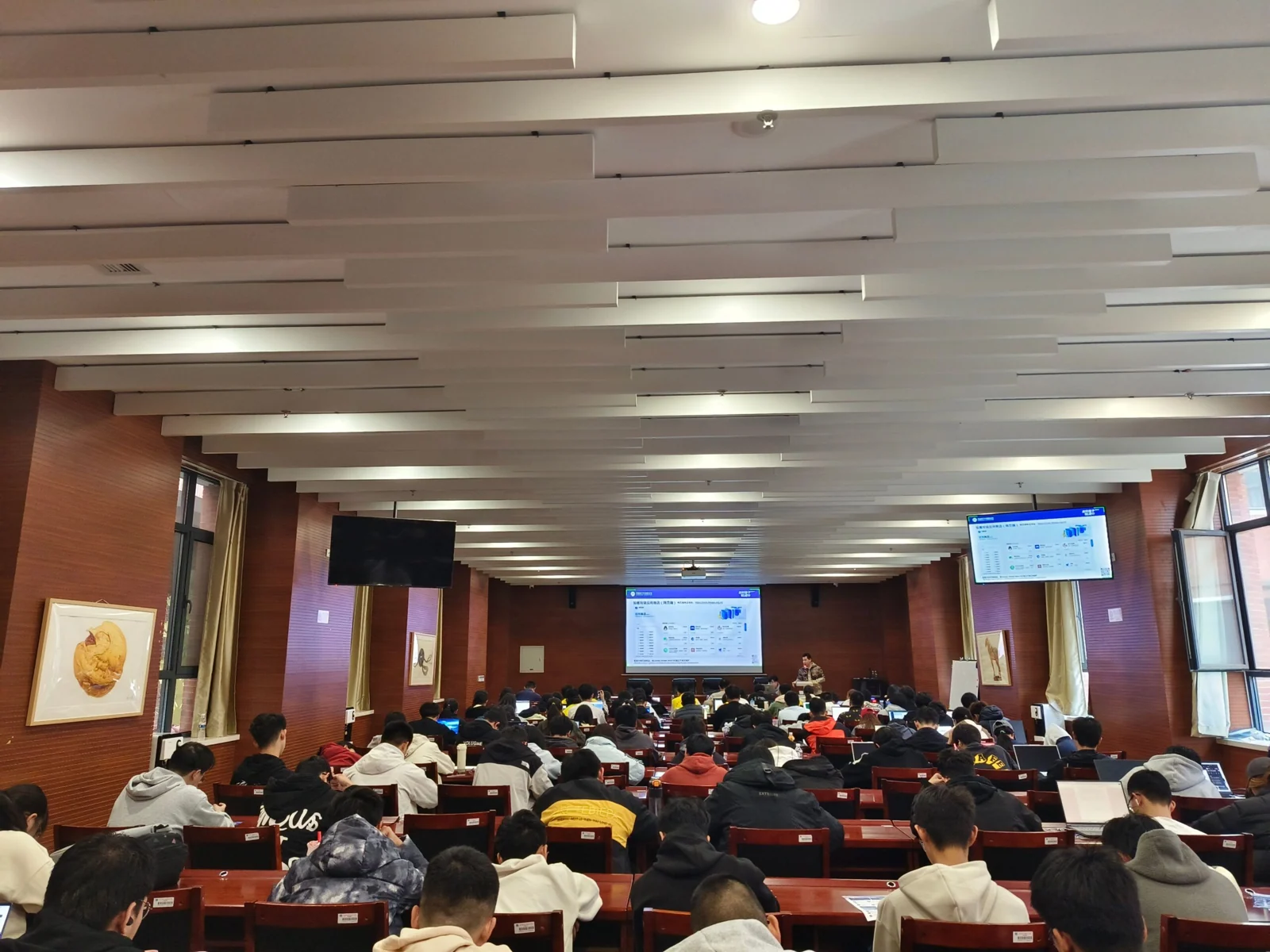
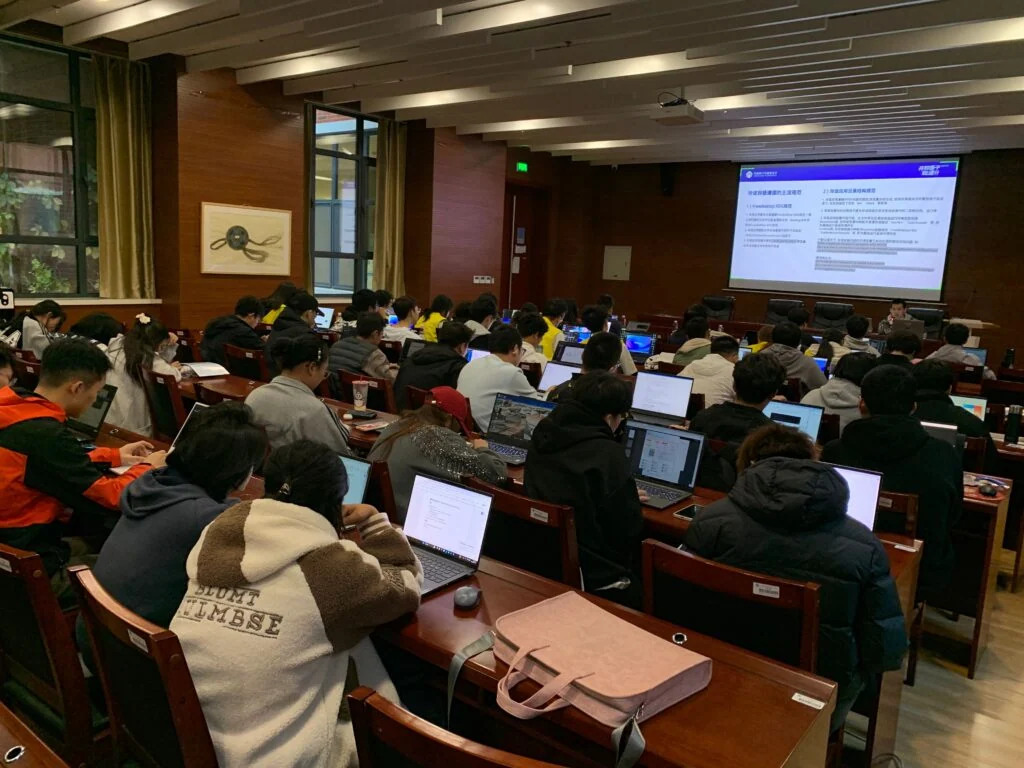
On the afternoon of November 16, with the support of the Open Atomic School Source Charity Project, the deepin community and the OpenTenBase community, the Linyaps community successfully entered Tianjin Sino-German University of Applied Sciences and held an interactive practical teaching Meetup focusing on open source general knowledge, technology, and community.
This event attracted the enthusiastic participation of more than 150 students from Tianjin Sino-German University of Applied Sciences and was shared with a wider audience through online live broadcast. The content of the activity covers multiple links such as project sharing and practical classroom operations. It introduces in detail the Linyaps compilation cases of open source, deepin operating system, Linyaps project and cooperative community OpenTenBase. In the practical classroom, participants are guided to experience Linyaps application packaging and open source project submission in depth, and lead everyone to truly enter the open source world and participate in the construction of the Linyaps community in a simple and easy-to-understand way.
Linyaps project Share
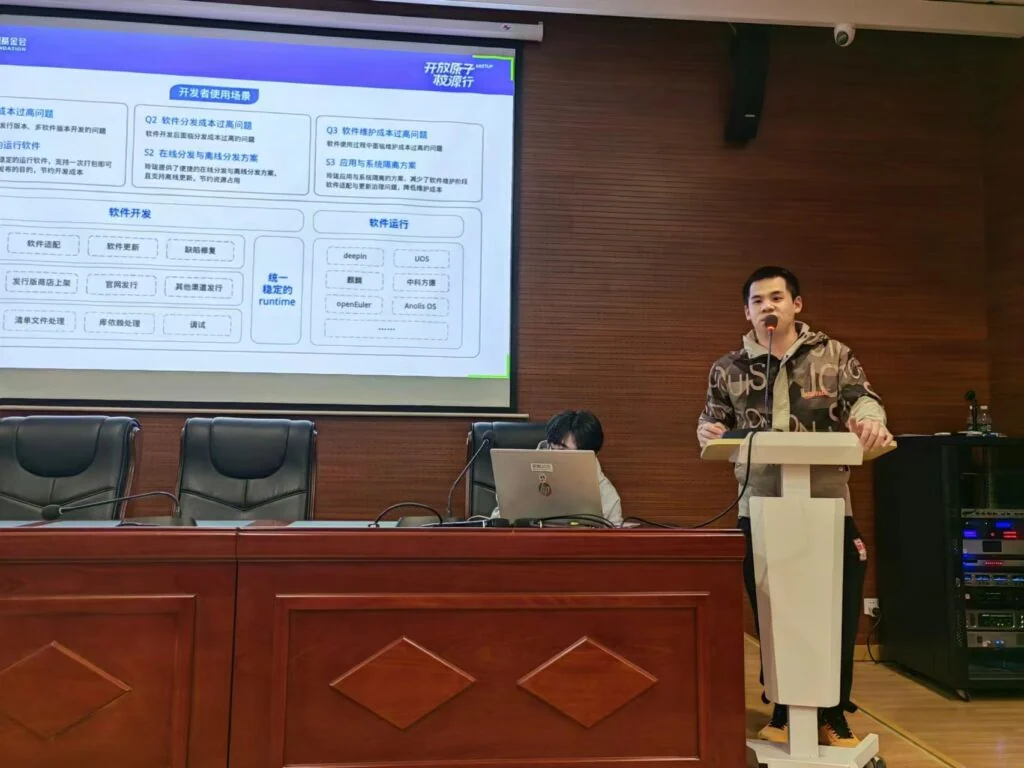
Instructor Lu Zijie shared the core concepts and technical features of the Linyaps project at the event: Linyaps is a new solution for Linux software distribution that focuses on solving compatibility issues caused by the complexity and cross-dependencies of traditional software package formats under Linux systems. As can be seen from the technical architecture, the biggest feature of Linyaps is its support for cross-distribution versions. Based on User Namespace, CGroup and other mechanisms, the project provides a unified application running environment that is independent of the operating system, which mainly includes libraries and dependencies commonly used in desktop applications such as Qt. These running environments support the coexistence of multiple versions, so that we can achieve "one architecture, one build".
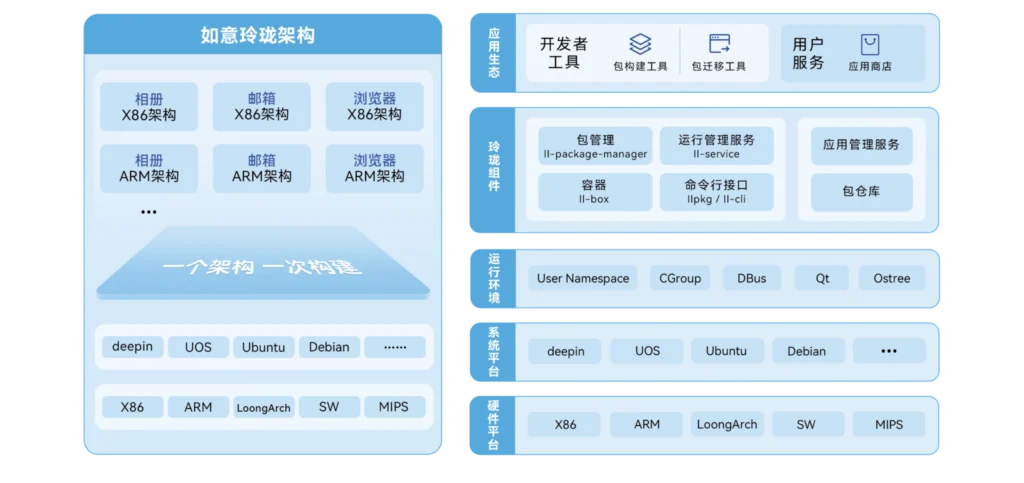
The instructor also shared some of the phased results achieved so far in the development of the Linyaps project, including support for multiple mainstream distributions and multi-CPU architectures, as well as the development of core downstream projects:
1) Supports multiple mainstream distributions (deepin 23, Anolis OS 23.2, UOS V20, openEuler 24.03, Ubuntu 24.04, Debian 12, openKylin 2.0)
2) Supports multiple CPU architectures (X86, ARM, Loongson)
3) Develop core downstream projects including:
Linyaps Simple Store SIG (Linyaps App Store)
Linyaps Generic-Linux SIG (Linyaps cross-distribution porting)
Electron Wrapper Next toolchains (web page packaging tool)
Next Linyaps Testing Toolchains (Application Testing Toolchain)
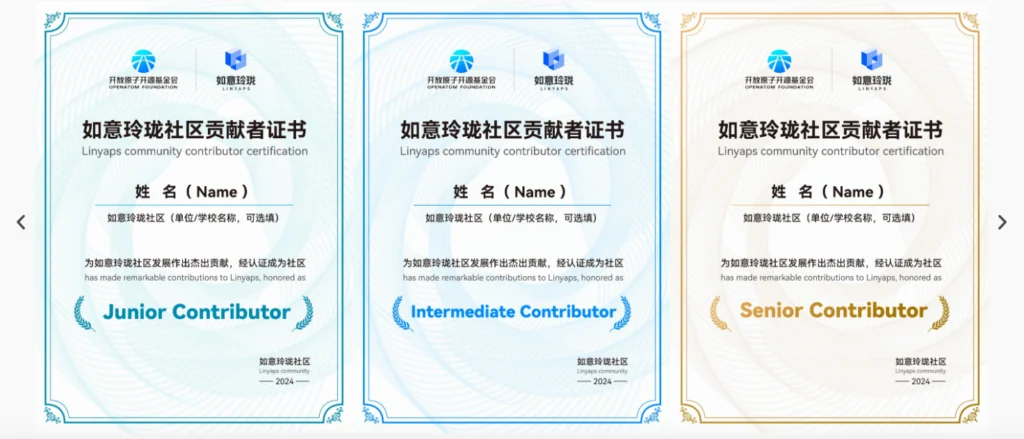
At the end of the project sharing session, the instructor introduced in detail how to participate in the contribution of the Linyaps community. Regardless of whether you have development capabilities or not, you can contribute to the development of the Linyaps community in various forms. For students who are interested in contributing to the application ecosystem, they can use the semi-automatic conversion tool ll-pica or the highly customized construction tool ll-builder provided by the project for application encapsulation and source code construction. Successfully packaged applications can be submitted through the Unison Developer Platform or the automated public build platform (GitHub-linglongdev). Developers who successfully submit Linyaps applications will receive a Linyaps community contributor certificate.
Linyaps Open Source Practice Classroom
After the project sharing session, the Linyaps open source practice class session provided participants with a wealth of learning and practical opportunities, including:
1) Linyaps application construction basic process and core specification learning
2) Demonstration of OpenTenBase project source code compilation in Linyaps container
3) Linyaps community practical open source tool chain learning
4) Linyaps packaging and operation practice of web games
5) Submission of practical classroom results
"Cross-border" sharing! Linyaps and OpenTenBase
In this event, we invited Mr. Zang Xiutao, the executive director of the cooperative community OpenTenBase, to share with us the greatly "cross-border" project OpenTenBase - an enterprise-level distributed HTAP open source database contributed by the Tencent Cloud Database team to the OpenAtom Foundation.
As a non-desktop application open source project, can Linyaps "Linyaps" it and successfully compile and produce binary programs? In order to explore this issue, Linyaps community instructors used OpenTenBase as a compilation case in the practical class session, conducted an on-site compilation demonstration of OpenTenBase, and successfully obtained a positive answer.
Submission of practical classroom results
The students on site were full of enthusiasm for learning in the practical class. Under the guidance of the instructor's carefully designed class sessions, they understood the basic process and core specifications of Linyaps application construction, and finally completed this practical task—successfully building a Linyaps application. Under the leadership of their instructors, dozens of students completed their first PR submission in the open source world on site and became true open source contributors. At the same time, this practice also allowed them to better understand the spirit and culture of the open source community, inspiring their enthusiasm to continue participating in open source projects. After the activity, the students continued to complete after-class practical tasks. Throughout the event, students contributed nearly 200 Linyaps games to the Linyaps app store.
With the successful conclusion of this event, we deeply feel that every exchange and practice is a valuable asset for the growth of the Linyaps community. We look forward to having more opportunities to enter the campus in the future and invite more future developers to join the construction of the Linyaps community. Through everyone's joint efforts, we believe that Linyaps can become the Linux software package format chosen by more people, and we look forward to our next gathering!
English edition: Linglong editorial · 18 October 2026. Original publication: 2024-11-18.