Preface: The Evolution of Package Managers
The Linux operating system has always been known for its open source nature and flexibility, and the most critical part of enabling a Linux system to successfully install and run the required software is Software Assurance Manager 。
In addition, there are many other package managers, such as yum, portage, pacman, etc. The diversity of package managers brings more choices to users, but the disadvantages are also very significant: Their packages cannot interoperate , which means that if a software is to be used on other distributions, it may need to be packaged repeatedly.
With the Linux kernel’s support for containers and the birth of Docker, a number of container-based package managers such as Snap and Flatpak have also begun to emerge. Software packages in this format are almost completely decoupled from the system environment and no longer rely on library files on the system (the same is true for AppImage), making application distribution gradually easier. However, problems such as high disk and memory usage and prolonged startup time have also arisen and have not yet been resolved.
Exploration: “Linyaps” came into being
Since deepin gave up Ubuntu as the upstream in 2015 and chose Ubuntu’s non-commercial upstream community Debian as the basis for research and development, we have received many users’ questions about software package management. Question feedback on , common ones include:
-
There are too few applications available on the system, and the available application versions are too old; -
After system update, some applications cannot be used normally; -
After installing certain applications obtained from other sources, ensure The processor cannot work properly, and the system may even become unusable.
The above problems have a common reason: Dependency binding is too strong 。 Due to the underlying library of the system, the application cannot be updated at will. When the interface of the underlying library changes, the application needs to be re-adapted to work properly.
-
Adapt Snap on deepin: Due to many compatibility issues with Snap in systems other than Ubuntu, it was abandoned. -
Convert some self-developed applications into AppImage: AppImage has good portability, and these applications can be easily used on other distributions. However, it does not have centralized repository storage and package management functions, nor does it provide the same level of sandbox as Snap and Flatpak. Its security cannot be guaranteed, and it is not suitable as the default package management method of the operating system. - In 2017, deepin followed up on the Flatpak format and completed 100+ software package construction work. However, due to various reasons such as large application size, excessive disk usage, and slow bug repair, it did not continue to adapt.
After experiencing various "frustrations" and based on our understanding of various package managers, we decided to design a software package management system ourselves.
After more than 3 months of technical research, more than 1 year of prototype verification, technical solution improvement and product polishing, Finally a set of advanced solutions - "Linyaps" came into being.
Top-level component diagram:
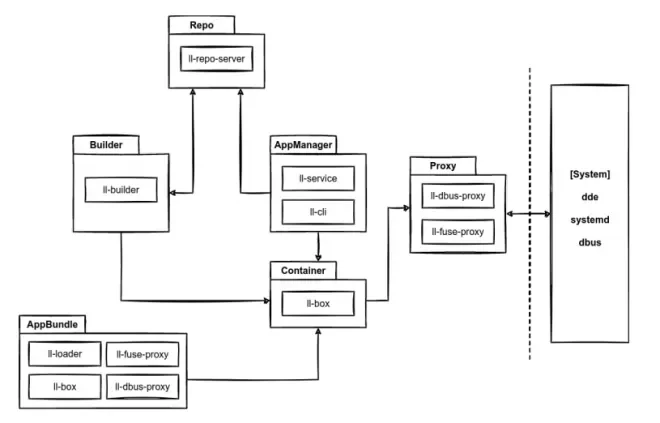
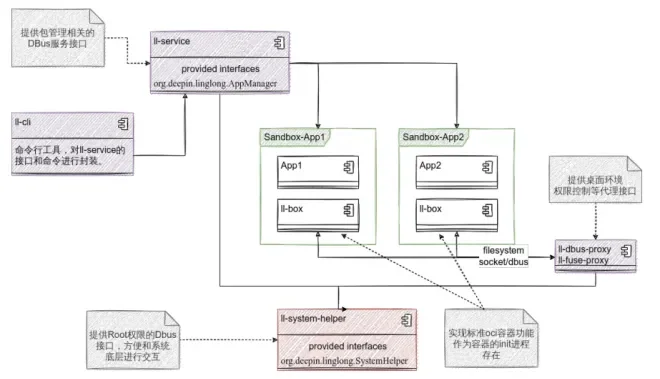
- Application sandbox (ll-box): An application sandbox operating environment designed in accordance with OCI standards. It uses the kernel Cgroup and Namespace features to isolate applications from the host environment and limit the use of system resources.
- Application management service (ll-service/ll-cli): Provides functions such as creating application sandbox environments and handling system compatibility issues. Complete the installation status/running status management of the application.
- Rights management proxy service (ll-dbus-proxy/ll-fuse-proxy): Provides rights management functions, including DBus interface and file interface.
- Application building tool (ll-builder): Provides a containerized application building environment to facilitate developers to build consistent applications in different environments.
- Individual packaging format (uab/AppBundle): Uniontech Application Bundle, application package packaging format, provides a binary package format that can be directly run.
- Repository system (ll-repo-server): Provides package upload , download, information statistics, query and other functions, the underlying storage uses OSTree.
Achievements: Solved compatibility issues and greatly improved performance
The emergence of Linyaps undoubtedly provides new ideas for solving this problem. Linyaps' isolation technology can completely decouple applications and systems, thereby completely solving compatibility issues caused by upgrades between systems and applications, and between applications and applications, while reducing the number of packaging times for distribution under different operating systems.
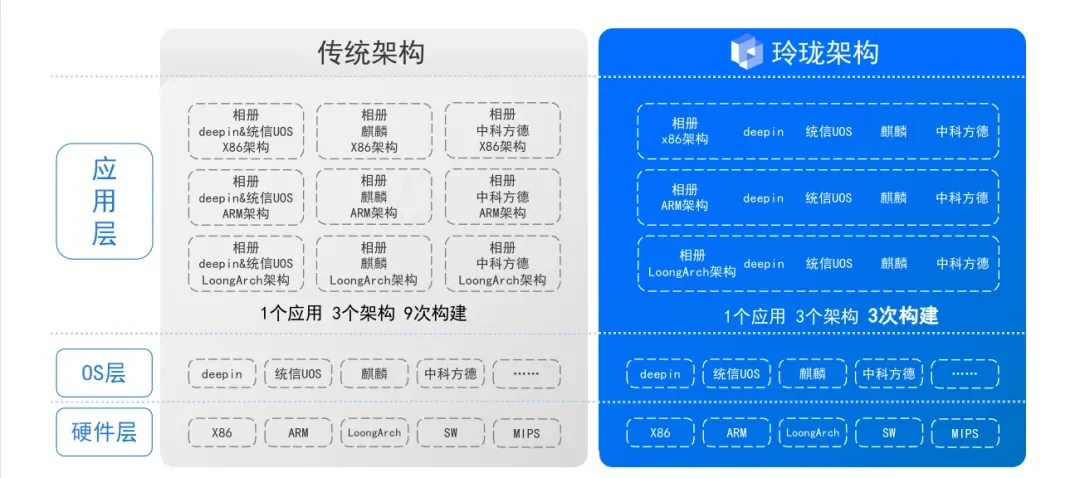
Traditional architecture Vs Linyaps architecture
-
Using non-full runtime (host system + Runtime), the overall size is smaller; -
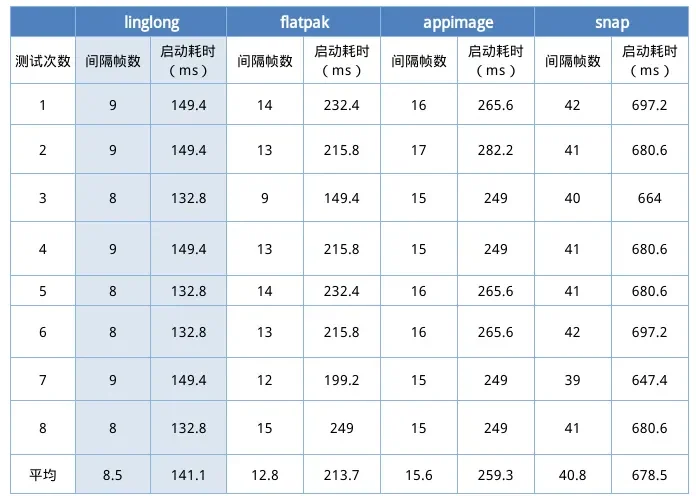
Due to the reuse of libraries on the host system, some library files that have been loaded into the memory can be used, and the startup speed will be faster. The startup speed of the same application under Linyaps is significantly improved; -
Provide development library hosting service, similar to NuGet, to facilitate developers to develop; -
Support Rootless (unprivileged) sandbox.
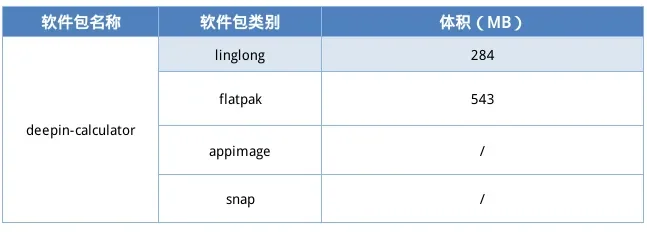
Software package size statistics:
Software package startup time-consuming statistics:
Future: Promote the healthy development of operating system software package ecosystem
2. User interaction
Currently, the update of Linyaps application requires users to manually update the command line, which requires a certain Linux foundation. And when there is a problem with the software package, the information about the build source, such as the hash value of the git project, cannot be directly queried.
In the future, the App Store will support Linyaps app updates. It also supports traceability, which allows developers to quickly query the hash value of the source file used by the software package, making it easier to track and solve problems.
3. Software package ecology
Ecological construction requires everyone's joint efforts. We are currently developing related software package conversion tools, which can easily convert existing deb, appimage and other format software packages into Linyaps applications. At the same time, we are also promoting the adaptation of existing cooperative software manufacturers to Linyaps.
Instead of walking alone, it is better to walk together. Ecological construction requires the joint efforts of everyone.
We sincerely hope that Linyaps can solve the problem of difficult application distribution for multiple distributions. We also look forward to more interested friends joining us to build an application distribution system and contribute to the healthy development of the operating system software ecosystem.
English edition: Linglong editorial · 18 October 2026. Original publication: 2023-08-29.