On this page
About LinyapsThe origin of LinyapsLinyaps HistoryTechnical FrameworkCore ProjectsProject ValueDeveloper valueCustomer ValueEcological valueReduce development costs and facilitate flexible distributionFast startup speed and low resource usageEcological developmentAbout Linyaps
The current project has been officially donated to OpenAtom Foundation , in the project incubation period
The origin of Linyaps

The Eight Treasures Linyaps Tower contains another world like the universe of mustard seeds. It looks like seven layers but is not, to show the changes in Taoism.
The word "Linyaps" perfectly combines the ideas of "isolation" and "layering", implying hierarchical management of the system environment during application runtime to achieve permission control.
Linyaps History
-
2017
Referring to the Flatpak package management solution, we tried to reconstruct and transform deepin's package management mechanism, and released the first batch of 100+ independent installation packages based on this technical solution, laying the foundation for the Linyaps package project.
-
2020
Drawing on the technical solution of sandbox/container, the core development of Linyaps prototype was quietly completed.
-
2022
As a core feature of the deepin distribution in the future, Linyaps is released with the deepin v23 preview version and is initially available.
-
May 24, 2024
Linyaps is officially donated to the OpenAtom Foundation, bringing together more industrial forces to jointly promote the development of Linyaps and accelerate ecosystem development.
Technical Framework
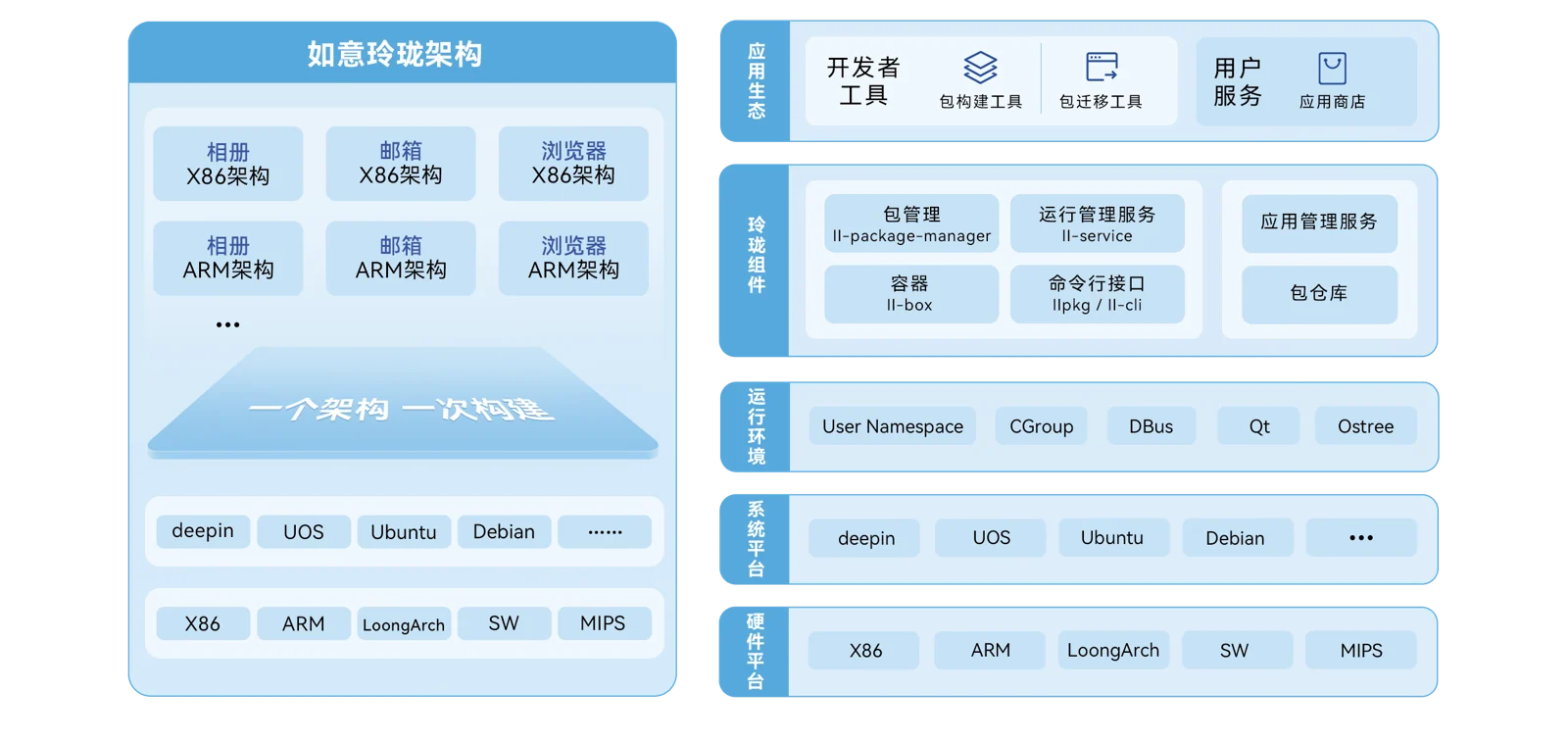
From the technical architecture, we can see that the biggest feature of Linyaps is its support for cross-distribution versions. Based on User Namespace, CGroup and other mechanisms, we provide a unified application running environment that is independent of the operating system, which mainly includes libraries and dependencies commonly used in desktop applications such as Qt. These runtime environments support the coexistence of multiple versions so that we can achieve "one architecture, one build".
Core Projects
Linyaps is an application operation and distribution specification based on namespace technology, including the following core projects
| Project name | Component name | Main functions |
|---|---|---|
| linglong-box | lI-box | Provide a runtime sandbox environment |
| linglong | ll-pkg/ll-cli | Package manager front-end tool, providing basic commands such as installation, uninstallation, update and startup |
| Il-package-manager | One of the package manager daemons, which manages the installation, update, and uninstallation of applications. | |
| ll-builder | Provide a containerized application construction environment to facilitate developers to build consistent applications in different environments | |
| linglongdbus-proxy | ll-dbus-proxy | dbus proxy tool, forwards corresponding dbus messages according to configuration rules |
| linglong-homepage | linglong-homepage | Linyaps official website, providing Linyaps official website homepage display and access services, including usage documentation |
| linglong-web-store | linglong-web-store | Linyaps web store, providing existing Linyaps application display and download entrance |
| ll-pica | ll-pica | Linyaps one-click conversion tool provides the ability to convert deb packages into Linyaps packages |
Project Value
Developer value
Simplify the packaging process
Reduce maintenance costs
Improve development efficiency
Customer Value
Enhance data security
Ensure business stability
Reduce operation and maintenance costs
Ecological value
Establish distribution standards
Improve ecological security
Breaking down platform barriers
Reduce development costs and facilitate flexible distribution
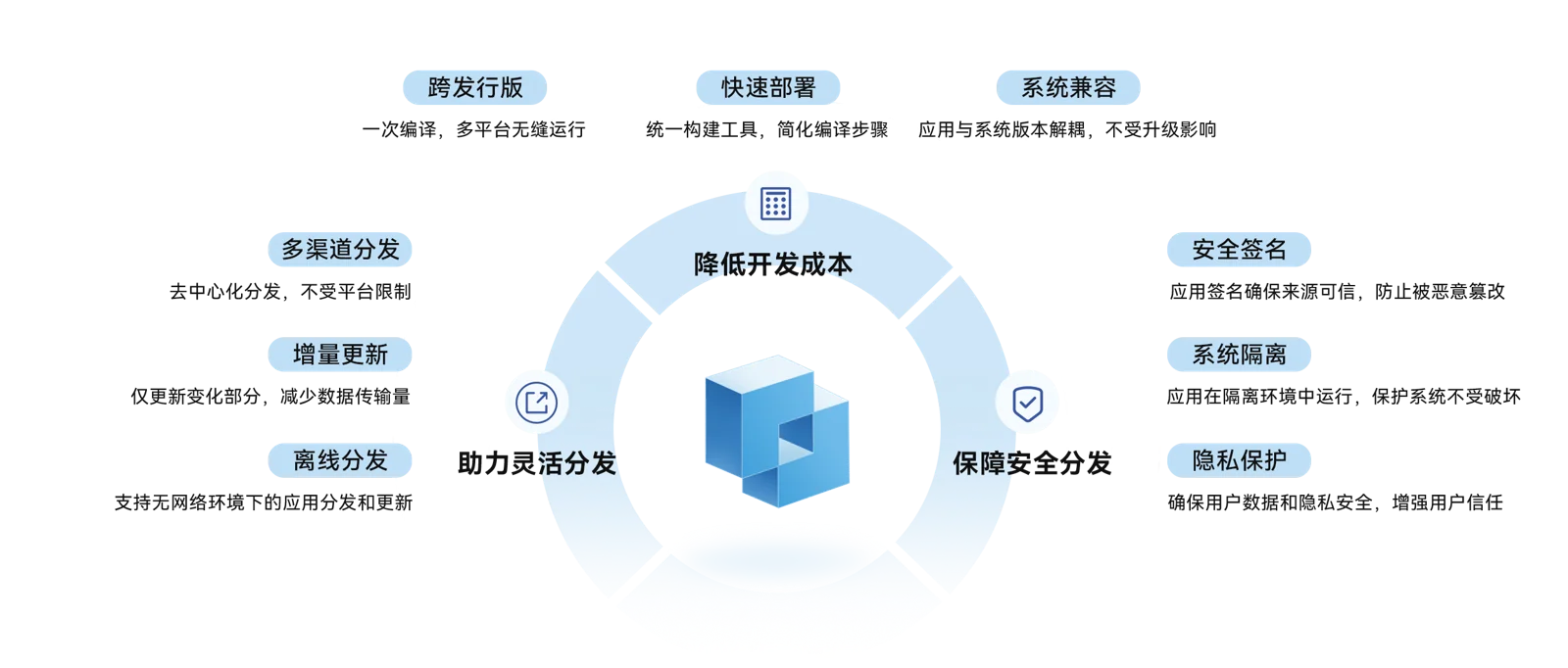
Fast startup speed and low resource usage
Using non-full runtime (host system + Runtime), the overall size is smaller
By reusing libraries on the host system, you can use some of the library files that have been loaded into the memory. The startup speed of the same application under Linyaps is significantly improved.
Support Rootless (unprivileged) sandbox
Provide development library hosting service, similar to NuGet, to facilitate development by developers
Ecological development
Cover more releases
Currently, the Linyaps project supports multiple distributions, including deepin, UOS, Euler, openKylin, Galaxy Kylin, openKylin, Ubuntu, Debian, ArchLinux, etc.
More distributions are being adapted...
Linyaps application continuous adaptation
The Linyaps application ecosystem is jointly built by the Linyaps project team, community enthusiasts and business partners to jointly promote the Linyapsization process of open source applications and commercial applications.
Currently, it has been successfully adapted to more than 5,000 Linyaps applications
English edition: Linglong editorial · 18 October 2026. Original publication: 2024-06-04.